

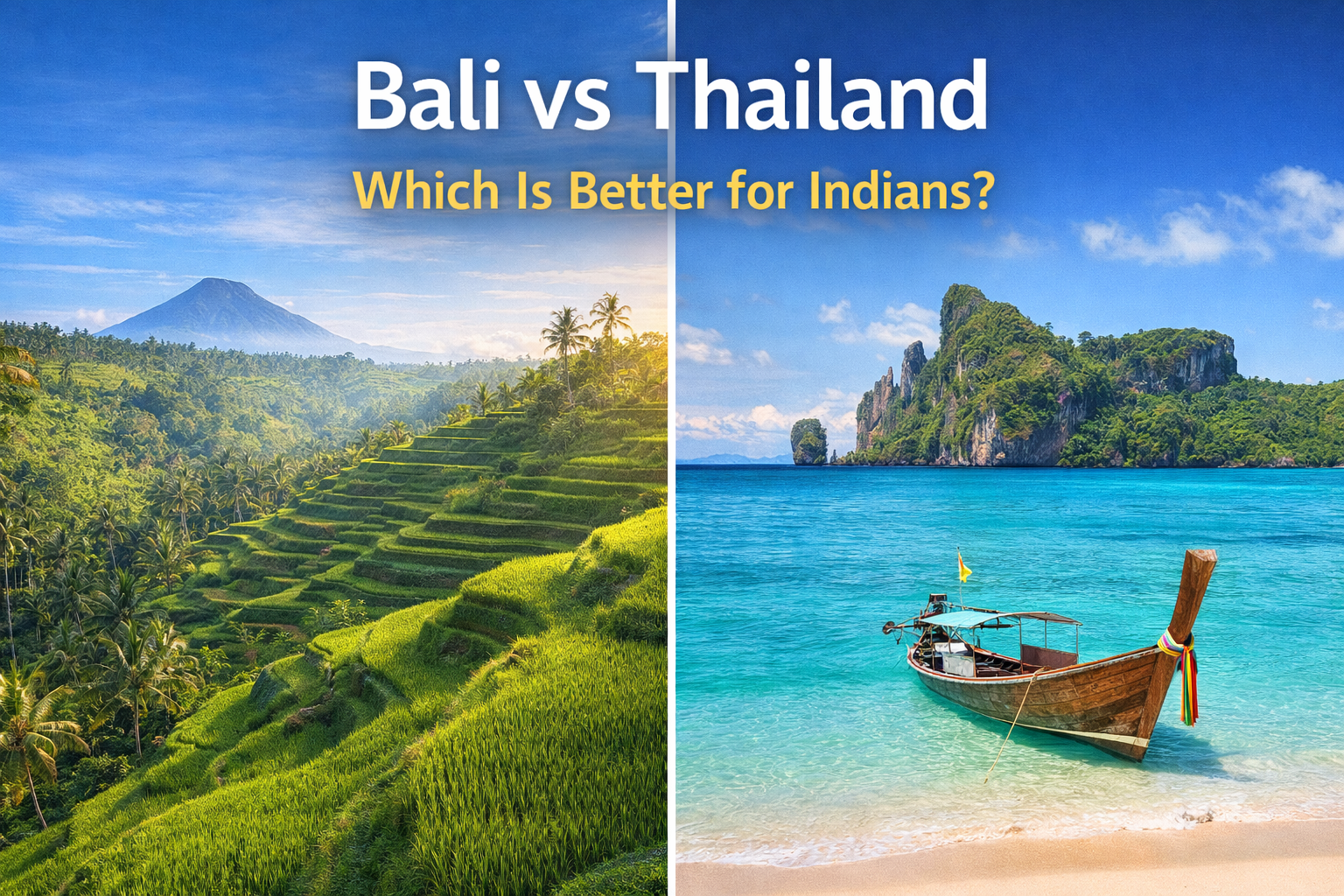
Bali vs Thailand for Indian Travelers: The Ultimate 2026 Head-to-Head Guide
Real-Time Vacation Strategy Signal: Both Bali and Thailand are tropical paradises, but their operational requirements for Indian passport holders have shifted drastically. This deep-dive comparison bypasses general holiday packages to evaluate actual 2026 visa costs, flight schedules, daily budgets, and on-the-ground logistics to help you spend your money wisely.
When planning a quick, accessible international beach holiday from India, your search will almost certainly come down to two iconic options: Bali (Indonesia) or Thailand.
While they look similar in travel brochures, they deliver completely different experiences for your wallet and itinerary layout. Between managing Thailand’s new entry checkpoints and navigating Bali’s updated electronic tax layers, making the wrong choice can lead to unwanted stress. Below is our direct comparison breakdown to help you pick the perfect destination for your next trip.
The 2026 Pocket Comparison Matrix
| Evaluated Dimension | The Thailand Path | The Bali (Indonesia) Path |
| Visa Category | Visa on Arrival (VoA) Reinstated | Visa on Arrival / e-VOA |
| Mandatory Entry Fees | 2,000 THB (~₹5,000) flat entry fee | IDR 500,000 (~₹2,950) + IDR 150,000 Levy |
| Pre-Travel Digital Forms | Thailand Digital Arrival Card (TDAC) | All Indonesia Arrival Card & Love Bali Levy |
| Average Non-Stop Flight Time | 3.5 to 4.5 Hours (Highly Accessible) | 7.5 to 9 Hours (Fewer direct routes) |
| Vibe Profile | Bustling cities, active nightlife, street food | Spiritual cafes, beach clubs, temple tours |
| Target 6-Day Budget | ₹55,000 – ₹70,000 per person | ₹75,000 – ₹95,000 per person |
Deep-Dive 1: The 2026 Entry Logistics & Fine Print
Navigating immigration checkpoints quickly sets the tone for your vacation.
The New Thailand Border Reality
The days of zero-fee, paperwork-free visa exemptions for Indians visiting Thailand have concluded.
- The Process: Under current guidelines, India sits in the Visa on Arrival (VoA) group. When you touch down, you must present a 2,000 THB cash processing fee (~₹5,000) right at the border kiosk.
- The Catch: You must fill out the free Thailand Digital Arrival Card (TDAC) online via the official portal within the 72 hours leading up to your flight.
Bali’s Dual-Layer Digital Entry
Indonesia offers a highly streamlined, paperless entry window, though it features multiple financial steps.
- The Process: While you can buy a physical sticker at Denpasar Airport (DPS) for IDR 500,000, it is highly recommended to file for the e-VOA (B1 Visa) online before departure to bypass the arrival queues.
- The Added Step: All incoming international tourists must pay the mandatory Bali Tourist Levy of IDR 150,000 (~₹850) via the official Love Bali portal and carry the generated digital QR code verification. You also need to complete the All Indonesia Arrival Card online within 3 days of landing to clear customs smoothly.
Make sure to plan around regional weather patterns by checking the best time to visit bali from india before booking your flights.
Deep-Dive 2: Airfare Dynamics & Commute Times
Flight availability directly dictates how much time you actually get to spend relaxing on the beach.
The High-Speed Thailand Grid

Thailand is unmatched when it comes to short flight times and convenience. Direct, non-stop flights link major Indian metros like Delhi, Mumbai, Bengaluru, and Kolkata directly to Bangkok (BKK/DMK) or Phuket (HKT) in just 3.5 to 4.5 hours. Multiple low-cost carriers compete along these routes daily, keeping round-trip fares highly accessible at ₹21,000 to ₹25,000 per seat when booked in advance.
The Long-Haul Bali Transit
Reaching Bali requires a bit more time and effort. Direct non-stop flight paths from India to Denpasar (DPS) are limited. Most affordable itineraries involve a layover in Kuala Lumpur (KUL) or Singapore (SIN), stretching your travel time to 9 to 13 hours. Because of the longer distances and multi-leg connections, average round-trip tickets range from ₹34,000 to ₹45,000, instantly raising your baseline trip cost.
Deep-Dive 3: Daily Expenses & Local Vibe
On the Ground in Thailand: Street Markets & Island Hops
Thailand is an excellent option for fast-paced, high-energy travel. Local transportation—from Bangkok’s BTS Skytrain to regional passenger ferries between Krabi and Phi Phi—is inexpensive and easy to use. Food is a major highlight; you can enjoy world-class street food, fresh pad thai, or local seafood at night markets for just 80 to 150 THB (~₹200 to ₹370) per meal.
On the Ground in Bali: Cafe Culture & Private Drivers

Bali rewards a more relaxed, slow-paced style of travel. The island lacks a robust public train or transit network, meaning you will need to download ride-hailing apps like Gojek or hire a private car and driver, which runs around IDR 500,000 to 700,000 (~₹2,800 to ₹4,000) per day. Dining centers heavily around aesthetic cafes and upscale beach clubs in Seminyak, Canggu, and Ubud, where western-style meals align closely with major Indian metro restaurant pricing.
Real-World Pitfalls to Avoid in Both Destinations
- The Cashless VOA Trap at Thai Airports: The Visa on Arrival counters inside Bangkok and Phuket terminals operate on a strict cash-only basis using physical Thai Baht currency banknotes. They do not accept international credit cards or digital Indian UPI links. If you land without physical THB notes, you will be directed to nearby airport currency conversion kiosks that offer highly unfavorable exchange rates.
- The Unofficial Bali e-VOA Website Scams: When searching for the Indonesian visa portal online, you will encounter numerous third-party lookalike sites designed to charge exorbitant service fees. Only use the official government page at
evisa.imigrasi.go.idor the VFS link to pay the standard IDR 500,000 fee. - Ignoring the Scooty License Reality: Renting a scooter in places like Phuket or Bali is incredibly popular but carries significant legal risks. Local traffic police frequently stop tourists at checkpoints. If you cannot present a valid International Driving Permit (IDP) stamped explicitly for two-wheelers alongside your Indian license, you will face immediate spot fines, and local travel insurance will not cover any potential accident claims.
Frequently Asked Questions (FAQ)
Q1: Which destination offers better vegetarian and vegan food options?
Bali is a world-class hub for health-focused, plant-based dining. Neighborhoods like Ubud and Canggu are packed with dedicated vegetarian, vegan, and organic organic cafes, making it incredibly easy to find diverse options without worrying about hidden meat bases.
Q2: Can I combine a trip to Bangkok and Bali within a single week?
It is highly discouraged. Due to the significant transit distances and the lack of direct flights connecting the two regions, you would spend two full days of your vacation just sitting in international airports and clearing border security checkpoints.
Q3: What is the minimum passport validity required to enter Indonesia and Thailand?
Both nations enforce a strict six-month passport validity rule starting from your exact date of arrival. Your passport must also feature at least two completely blank pages for entry and exit stamps. If your passport expires within five months, airlines will deny you a boarding pass right at your Indian departure gate.