
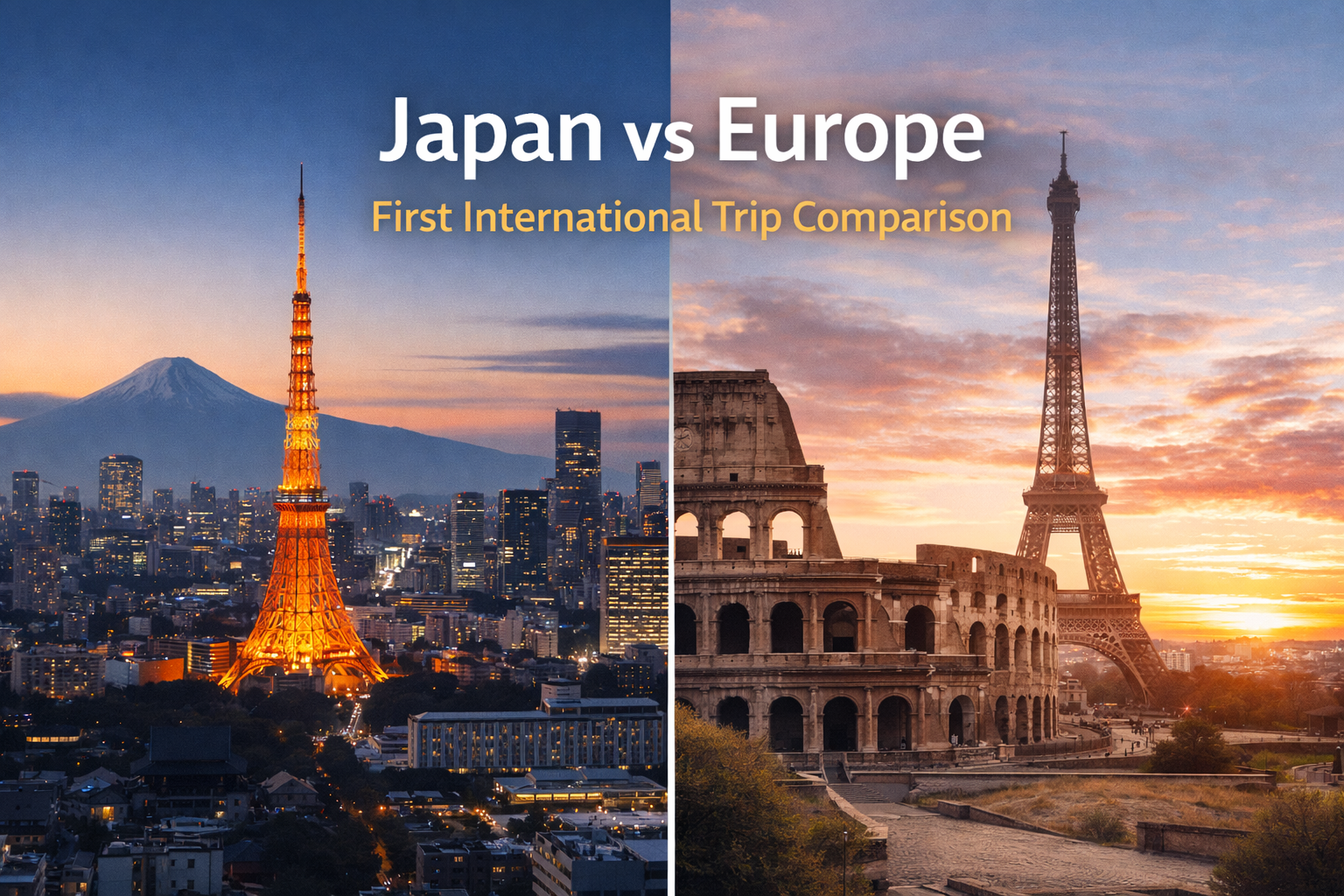
Japan vs Europe for Your First International Trip from India (2026 Guide)
First-Timer Transparency Signal: Choosing the destination for your first stamps outside of India is a major decision. This head-to-head comparison evaluates actual 2026 visa processing timelines, flight routes from Indian hubs, currency purchasing power, and local logistical comfort to help you choose the ideal itinerary.
Planning your very first international holiday from India usually brings you to a classic crossroads: Do you opt for the neon lights, bullet trains, and shrines of Japan? Or do you plan a multi-country trip across Europe’s historic cities?
Both destinations offer incredible travel experiences, but for a first-time traveler departing from India, they present vastly different logistical, financial, and visa frameworks. Below is our direct comparison breakdown to help you match a destination to your travel style and budget.
The First-Timer Comparison Matrix (2026 Baselines)
| Evaluated Metric | Japan Travel Path | Europe Travel Path (Schengen Zone) |
| Visa Process Type | Fully Online eVisa (No VFS appointment required) | Physical VFS Biometric Enrollment Required |
| Visa Baseline Fee | ₹500 (Single Entry for Indian Nationals) | €90 (~₹8,300 base fee) |
| Average Flight Time | 7 to 8 Hours (Direct from DEL/BOM) | 9 to 11 Hours (Direct to Central Europe) |
| INR Purchasing Power | High (Favorable INR to JPY exchange) | Moderate to Low (Strong Euro margins) |
| Primary Transit System | Seamless Shinkansen (Bullet Trains) | Extensive Eurail Pass / Regional Flights |
| Target 7-Day Budget | ₹1,25,000 – ₹1,45,000 per person | ₹1,85,000 – ₹2,20,000 per person |
Deep-Dive 1: The 2026 Visa Infrastructure Battle
The ease of getting your tourist visa is often the deciding factor for a first international trip.
Japan’s Streamlined eVisa Channel
Japan has emerged as an incredibly accessible destination for Indian passport holders due to its updated JAPAN eVisa system.
- The Process: If you are traveling for short-term tourism (up to 90 days), you can complete your entire application online via the official MOFA portal. You upload your passport scans, financial statements, and flight details digitally.
- The Highlight: You completely bypass physical biometric appointments. The official visa fee is a highly wallet-friendly ₹500 for Indian citizens.
Europe’s Digital Shift & The Cascade Regime
Entering the 29-country Schengen Zone remains a more document-heavy, rigorous process.
- The Process: Even with the rollout of digital visa barcodes, first-time Indian applicants must still book a physical VFS Global appointment for biometric fingerprinting and facial scans.
- The System: The EU’s Entry/Exit System (EES) records biometric data right at the border control gates.
- The Silver Lining: If you travel frequently, the Schengen Cascade Regime offers a structured path to a 2-year multiple-entry visa after you successfully use two short-stay visas within a three-year window. However, for a first-time international traveler, the initial application demands strict financial documentation and carries a base fee of €90 (~₹8,300).
To dive deeper into seasonal details, check our comprehensive guides on the best time to visit japan and the best time to visit europe from india.
Deep-Dive 2: Financial Planning & Exchange Rate Realities
The Strength of the Rupee in Tokyo
Japan currently offers fantastic value for money for Indian travelers. The favorable exchange rate between the Indian Rupee and the Japanese Yen means your daily budget stretches significantly further. High-quality meals at local spots like family restaurants, conveyor-belt sushi joints, or convenience stores (like 7-Eleven or Lawson) cost around ¥600 to ¥1,200 (~₹350 to ₹700), allowing you to experience the local culinary scene affordably.
Navigating the Euro Standard
Europe requires a larger initial investment. The Euro holds a strong premium over the Rupee, meaning sit-down dining, cafe visits, and entry tickets for major historic monuments will quickly add up. A standard mid-range lunch in hubs like Paris, Amsterdam, or Rome regularly starts around €18 to €25 (~₹1,600 to ₹2,300) per person. To keep your budget under control, you will need to balance your meals by sourcing fresh options from local supermarkets (like Lidl, Carrefour, or Aldi).
Deep-Dive 3: On-the-Ground Logistics & Cultural Comfort
Navigating Japan as a First-Timer
- The Transit Advantage: Japan’s public transportation is famously precise and efficient. Purchasing a regional train pass or using a digital IC card (like Suica or Pasmo) on your smartphone allows you to navigate local subways and high-speed bullet trains seamlessly. Street signs, digital maps, and train station announcements are all clearly presented in English.
- The Dietary Strategy: For Indian travelers who stick to a strictly vegetarian or vegan diet, Japan requires a bit of pre-planning. Traditional stocks often use a fish base called dashi. The Fix: Download apps like HappyCow and carry bilingual dietary definition cards to clearly communicate your preferences at local restaurants.
Navigating Europe as a First-Timer
- The Transit Advantage: The Eurail network makes it easy to explore multiple countries—allowing you to watch the landscape change from the canals of Amsterdam to the mountains of Switzerland right from your train window.
- The Dietary Strategy: Europe is highly accommodating for varied dietary preferences. You can easily find diverse vegetarian, vegan, and familiar continental options across every major city center.
Common First-Time Pitfalls to Avoid
- The “Too Many Countries” Europe Trap: A frequent mistake on a first trip to Europe is trying to see five different countries in seven days. You end up spending most of your vacation time checking in and out of hotels, packing bags, and sitting on long train rides. Stick to a maximum of two closely connected regions (e.g., Netherlands and Belgium, or just a deep-dive across Switzerland) to truly enjoy the experience.
- Ignoring the Japan Document Limits: When applying for the Japan eVisa, ensure your uploaded digital documents strictly fit within the required 2MB to 5MB file size limits. Uploading blurry smartphone photos of your bank statements rather than high-resolution, clear PDF files can trigger an immediate application cancellation, delaying your travel schedule.
- Schengen Accommodation Rule: For your Europe application, your flight itineraries, cover letter details, and hotel reservations must align perfectly. Booking placeholder hotel reservations that you cancel before your visa is officially stamped can result in an unexpected visa rejection due to document inconsistency.
Frequently Asked Questions (FAQ)
Q1: Is language a major barrier for independent Indian travelers in Japan?
Not at all. While English isn’t universally spoken, all public transit systems, street signs, and major menus feature clear English translations. Using live translation apps on your phone makes it easy to communicate seamlessly with locals.
Q2: Can I apply for a Schengen visa via the VFS center of any country?
No. You must submit your application to the embassy of the country where you plan to spend the most nights during your trip. If your time is split exactly evenly between two destinations, you must apply through the country that serves as your initial point of entry.
Q3: Which destination is better suited for a multi-generational family trip?
If you are traveling with elderly parents or young children, Japan’s extensive elevator networks, pristine public restrooms, and smooth train connections offer exceptional convenience and comfort for the whole family.